| • | AKA Sneddon-Wilkinson disease |
| • | rare, chronic, relapsing |
| • | sometimes associated with IBD, PG: relation unclear, but all respond to sulfone sulfonamide treatment |
clinical:
| • | flaccid pustules arise in crops within a few hours on clinically normal or erythematous skin |
| • | tendency to coalesce and form annular, circinate or bizarre serpiginous patterns |
| • | hypopyon is characteristic |
| • | predilection for the trunk, especially intertriginous/flexures |
| • | usually spares face and mucous membranes |
| • | no constitutional symptoms |
| • | course: benign condition, attacks recur over many years lasting from a few days to several weeks |
| • | DIF (+) for IgA in pemphigus-like intercellular pattern |
| • | IgA vs. desmocollin's I & II |
| • | might call “IgA pemphigus” but: no complement on DIF, benign course, (-) Nikolsky, and neutrophils (instead of eos) |
| • | circulating IgA present in half the cases; IgA monoclonal gammopathy in 20% of cases |
|
histology:
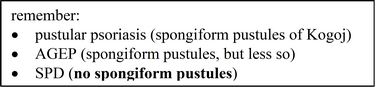
| • | subcorneal pustule with virtually no spongiosis (therefore no intraepidermal spongiform pustules) |
treatment:
| • | sulfones (less dramatic than DH, but complete remission is most often obtained) |
ddx:
| • | DH – but DH has: subepidermal vesicles, highly pruritic, extensor surface (vs. flexor) |
| • | pemphigus foliaceus – may be misdiagnosed as SPD clinically and histologically (if acantholysis is not prominent), but DIF makes the diagnosis |
systemic symptoms (fever, malaise, leukocytosis); presence of spongiform pustules within the epidermis, and failure to respond to sulfones distinguish it from SPD
| • | the fact that the subcorneal pustule of SWD sits on the surface of the epidermis rather than being an integral part of it |
| • | also check elbows, knees, and nails for psoriasis |
|
| • | glucagonoma syndrome – differentiated by its distribution, lack of actual pustule formation, erosions of lips and oral mucosa; histology = necrobiosis of upper dermis |
|
